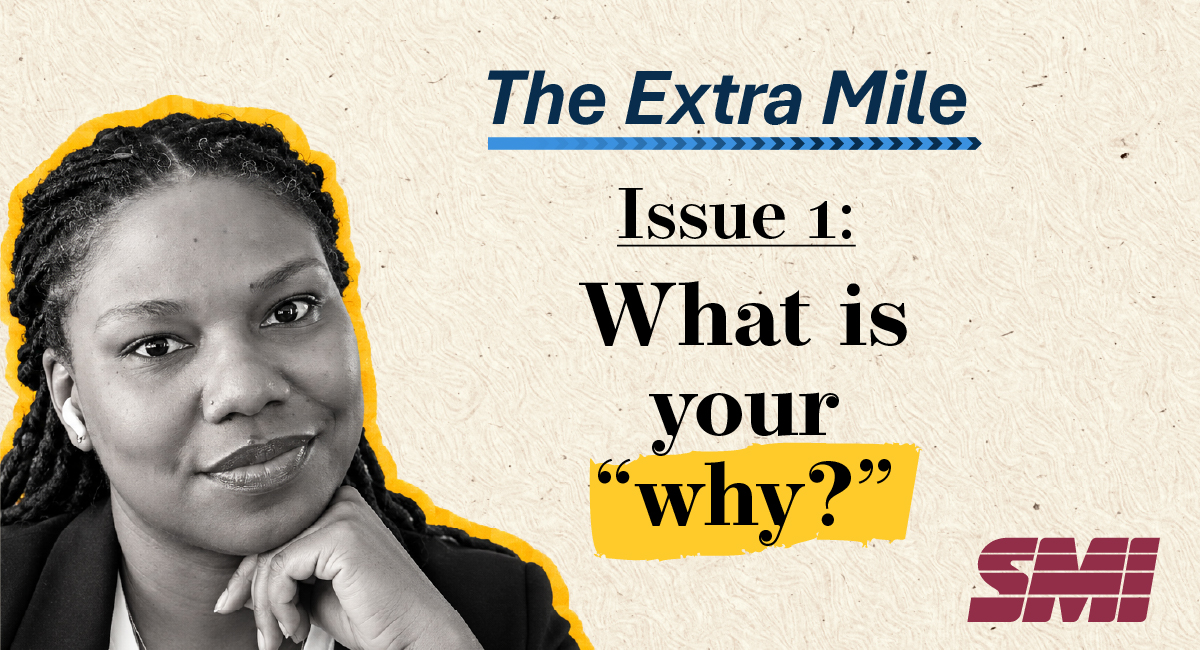
In this first edition of SMI's newsletter, The Extra Mile, we decided to do things a little differently. The format, the intro, all of it. It's late October, and that means we're all marching into (willingly or otherwise) the biggest shopping season of the year. Grocery shopping for larger-than-normal family and friends holiday dinners, gift shopping for the Christmas season, and more. This is all in addition to regular bills that don't magically disappear in the final three months of the year.
What better time to do a little self-reflection? Why do we do this work that we do in the child support space, or to pose that question a different way—what is your "why?"
I waited a few months after joining SMI before I sat down with Jewel to hear her story.
Not because I didn't want to ask her to tell it--but because it's so personal. How do you even approach a stranger and ask about her childhood experience with child support?
I knew my reason for wanting to hear it. Perspective. I'd already heard from my SMI teammates: "You need to talk to Jewel Rogers." "Talk to Jewel--her story is incredible."
So, I gave it a few weeks and messaged her about it. Instantly glad I did.
We jumped on a call and just talked. Like we were old friends—not strangers—just catching up.
This first edition of The Extra Mile is simply a story worth reading.
-Phillip Elder, Director of Marketing
By Jewel Rogers
I was seven years old, standing at the window, watching Mom walk back from the mailbox.
I didn't need to see what she was carrying. I can tell from her shoulders. Back straight, chin up — a check came. Shoulders low, walking slower than she needs to — it didn't. And whichever way those shoulders fall decides the rest of the day: whether there's dinner, whether my brother keeps his spot in marching band, whether the white envelope with the blue check inside is sitting on the counter or nowhere at all.
All I can do is watch. I'm just a kid at a window.
We were the child support family in the neighborhood. We were the ones that needed it.
I didn't know it yet, but I would spend the next thirty years finding out what happens on the other side of that mailbox.
The Job Hunt
So, back in 1999 I was working at a bank in my hometown and a couple of the guys said there was an ad in the paper for a company in Raleigh that were paying $10 an hour. Ten bucks?! That was enough for us to check it out. We piled in the car, drove up, and got hired on the spot! After waiting a couple of weeks, we walked in for day one. It was basically a warehouse — tables, chairs, and rows of people I didn't know. Nobody told me what the company did and I didn't ask. I ran a machine that printed checks, eight hours a day, and watched them print, one after another, names and numbers until I got to 500 of them.
After about a week, I started hearing the term "child support" getting thrown around, and somebody said, "Oh, you work in Raleigh. You work for the child support people." I said, "I don't think so. I just work on a machine that puts numbers on the bottom of checks."
A week later, I read one of them.
North Carolina child support.
The machine kept running. The checks kept coming. But something in me went still for a second—white envelope, blue check, a child support payment—the very thing I used to watch Mom carry up the driveway, and here it is again, except now it's coming out of the machine I'm working.
I'm not the kid at the window anymore. I'm the one printing the check.
That's how I became an SMI employee, and I'm not talking about that moment specifically.
The Weight of an Envelope
From there, my path wound through machine operator, customer service, quality assurance, and a stint as financial supervisor for the North Carolina SDU, before I landed in operations — testing products, fixing what breaks, making sure the systems behind the scenes hold up for the people depending on them.
Somewhere in customer service, I started receiving calls. Parents, mid-crisis. "My lights are about to get turned off. Did he pay anything?" I always wondered how much they needed, wishing I could just help out. But that was never the job. I can't even count how many times I'd drive home wondering if the lights stayed on or got turned off. That's some weight.
It got heavy for a while. Heavy enough that leaving the job crossed my mind.
I keep coming back because I've figured out something about the shape of it: I don't work in the SDU anymore, I don't have my hands on a check going out the door. But when I close a ticket on a broken website, someone else's check goes through a little faster because of it. It's not the machine. It's not the mailbox. But it's the same thing, underneath.
Windows, Mailboxes, and the "Why"
It's a different world today. "Checking the mailbox" today might mean signing into online banking to see if a deposit hit or not. I'd bet reading the reaction is the same though. Log in, smile, we're getting a happy meal tonight! Log in, frown, no new deposits. There's a kid somewhere, a mom somewhere, that literally doesn't have enough money to get through the day. Can I make sure the system is working fine, so she'll get it? I can try, right?
That's the whole job, whether you're a caseworker, a county administrator, a federal analyst, or the person quietly keeping a payment system standing. Somewhere on the other end of what you do, there's a kid at a window, watching to see which way the day is going to go.
If there's ever been a better "why," I haven't found it. That is my "why."
I still check in with myself about it, thirty years in. Not because anyone asks me to but because it's easy to forget, and I'd rather not.
Consider this a check-in. What keeps you coming back to the weight of this work? This sometimes-heart-breaking, always-beautiful, heavy, and amazing work in child support.
What's your "why?"
